




Start With the Product
The first question when purchasing a Vacuum Freeze Dryer should not be “How big is the machine?” It should be “What food will be processed?”
Fruit, vegetables, meat, seafood, coffee, dairy products, prepared meals, and pet food have different moisture levels and structures.
A Food Freeze Dryer should therefore be selected around the product rather than around a generic capacity number.
For example, products with high initial moisture may place a larger vapor load on the condenser. Dense foods can also require longer primary drying. Sugary or fatty products may behave differently during freezing and drying.
Determine Required Capacity
Capacity is normally evaluated in kilograms per batch or kilograms per day.
However, capacity alone can be misleading.
Suppose a production line requires 1,000 kg of finished product per week. A machine capable of 500 kg per batch might appear sufficient, but the real calculation must include product moisture, loading density, drying time, freezing time, unloading, and sanitation.
The correct Freeze Dryer size should therefore be determined using an actual production model.
Evaluate the Vacuum System
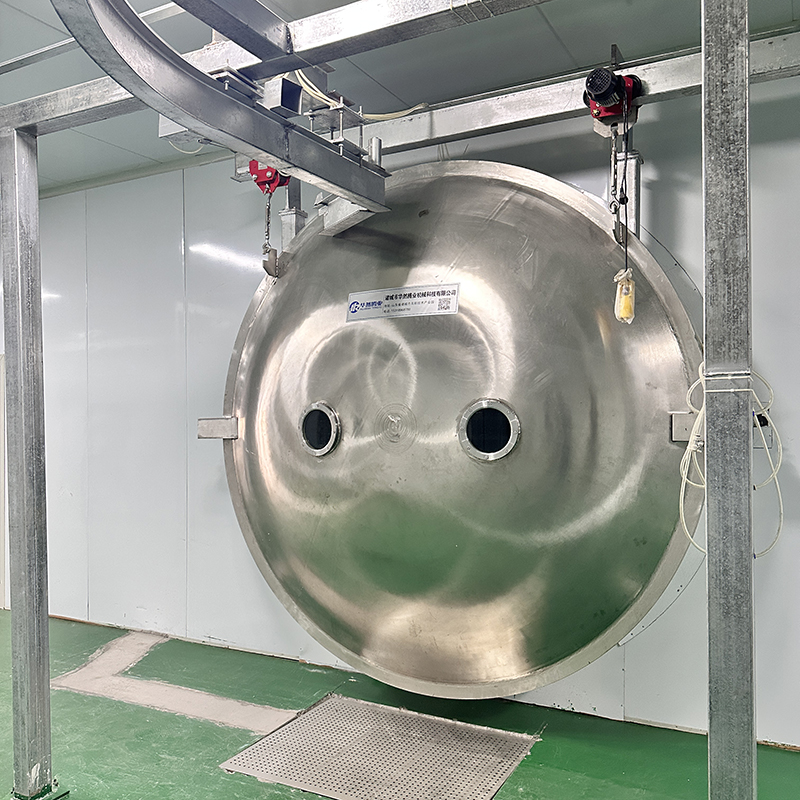
Vacuum performance is one of the defining characteristics of a Vacuum Freeze Dryer.
During primary drying, pressure must be low enough to allow ice sublimation. The vacuum pump removes non-condensable gases, while the condenser captures water vapor.
A poorly balanced system can reduce drying efficiency or create inconsistent product conditions.
Industrial buyers should ask about vacuum-pump type, pumping capacity, operating pressure, maintenance requirements, and system protection.
Consider the Condenser
The condenser is another critical component.
When water leaves frozen food as vapor, the vapor must be captured efficiently. The condenser therefore needs sufficient capacity for the expected product load.
A Commercial Freeze Dryer designed for high-moisture products needs a condenser capable of handling a substantial vapor load without losing process stability.
ScienceDirect describes freeze dryers as systems combining a vacuum chamber, heated shelves, vacuum pumps, refrigeration equipment, and cold surfaces for vapor condensation.
Examine Shelf Temperature Uniformity
Shelf heating affects sublimation.
If one section of the shelf is substantially hotter or colder than another, different products may dry at different rates.
For a commercial Food Freeze Dryer, uniform heat transfer supports more consistent batches.
Buyers should therefore ask about shelf construction, heating control, temperature sensors, and validation procedures.
Control and Automation
Modern freeze-drying equipment increasingly depends on intelligent control.
A good Freeze Dryer should coordinate refrigeration, vacuum, heating, and cycle parameters rather than forcing operators to manually manage every stage.
Programmable recipes are especially useful when the factory processes multiple products.
Zhucheng Huaran Tengye states that its technical development focuses on vacuum systems, refrigeration systems, and intelligent control systems.
Sanitary Construction
For food applications, equipment hygiene is essential.
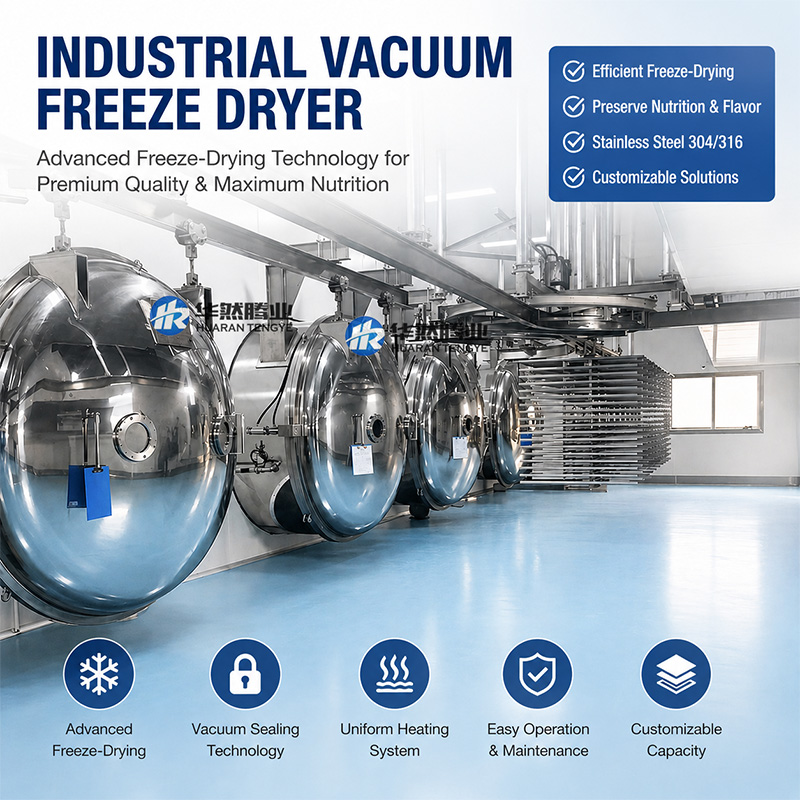
A Food Freeze Dryer should be designed around food-processing requirements, including appropriate stainless-steel construction, accessible surfaces, drainage, and cleaning procedures.
The surrounding production line also matters. Loading, unloading, packaging, and storage must prevent the dried product from rapidly absorbing moisture again.
The USDA notes that freeze-dried food should be placed in moisture-proof, hermetically sealed packaging for shelf stability.
Why Manufacturer Capability Matters
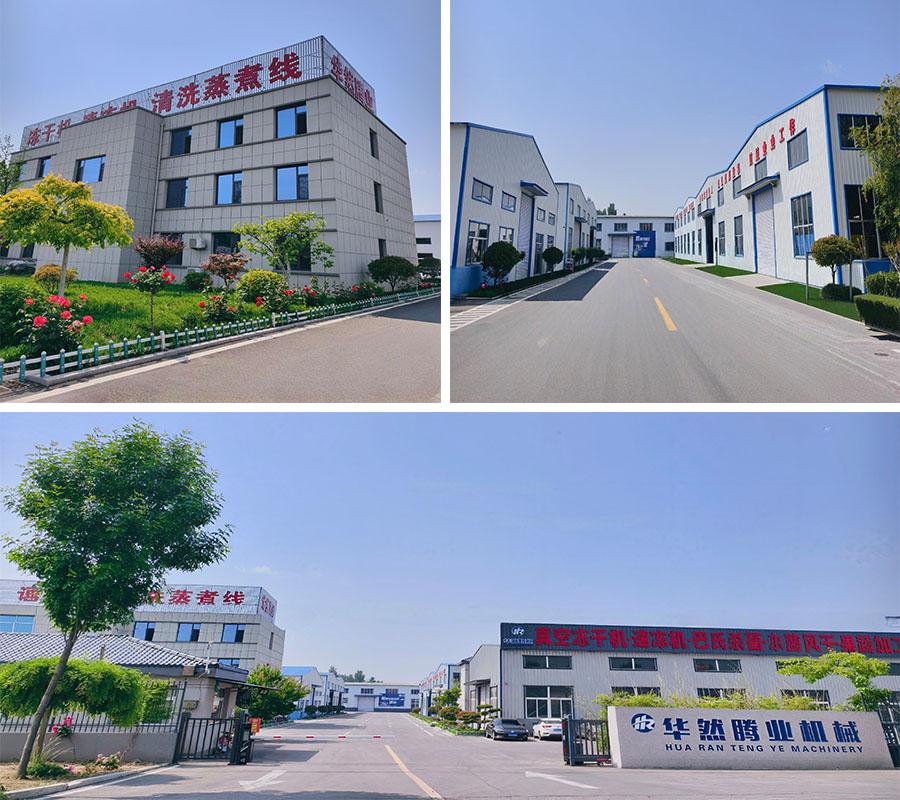
Zhucheng Huaran Tengye Machinery Technology Co., Ltd. reports a 17,000 m² production facility and more than 100 professional employees, supported by more than 19 years of manufacturing experience.
Its production system covers design, manufacturing, assembly, testing, and delivery. This vertical control can be important when a customer needs equipment configured around specific production conditions.
The company also reports exporting equipment to more than 100 countries worldwide.
Ask for a Product Test
Before buying a Vacuum Freeze Dryer, serious processors should provide representative food samples whenever possible.
Testing can reveal:
Actual drying time
Final moisture
Product appearance
Rehydration behavior
Weight reduction
Texture
Batch uniformity
Energy consumption
These measurements are more useful than relying only on a catalogue specification.
A Practical Selection Checklist
When comparing a Commercial Freeze Dryer, ask:
What is the usable tray area?
What is the expected batch load?
What condenser capacity is available?
What vacuum system is installed?
How is shelf temperature controlled?
What materials are used for food-contact surfaces?
How easy is cleaning?
What automation and data recording are available?
What installation support is provided?
Can the supplier test the actual product?
A reliable Freeze Dryer is an integrated engineering system. By evaluating the product, process, capacity, vacuum system, refrigeration, controls, hygiene, and supplier capability together, food processors can make a much more informed investment.
