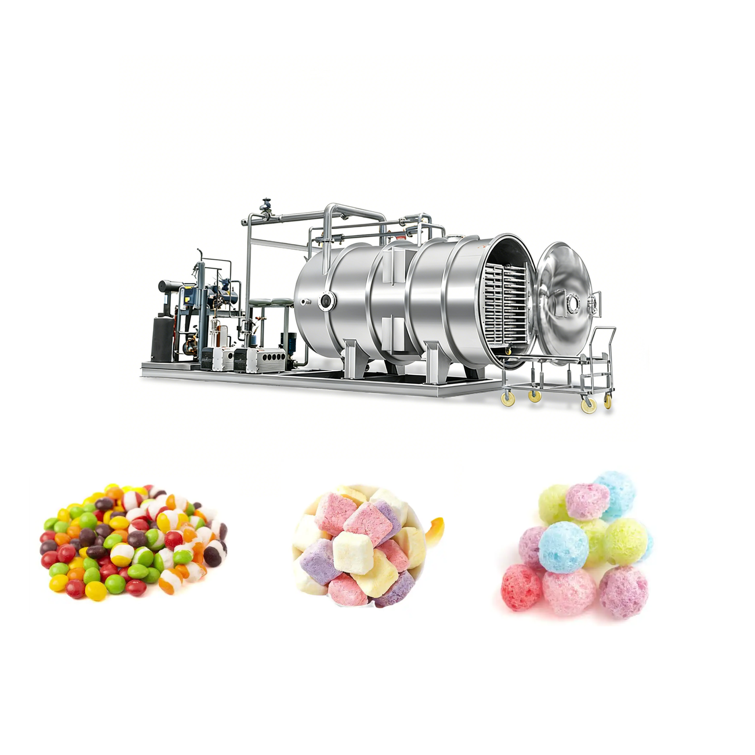
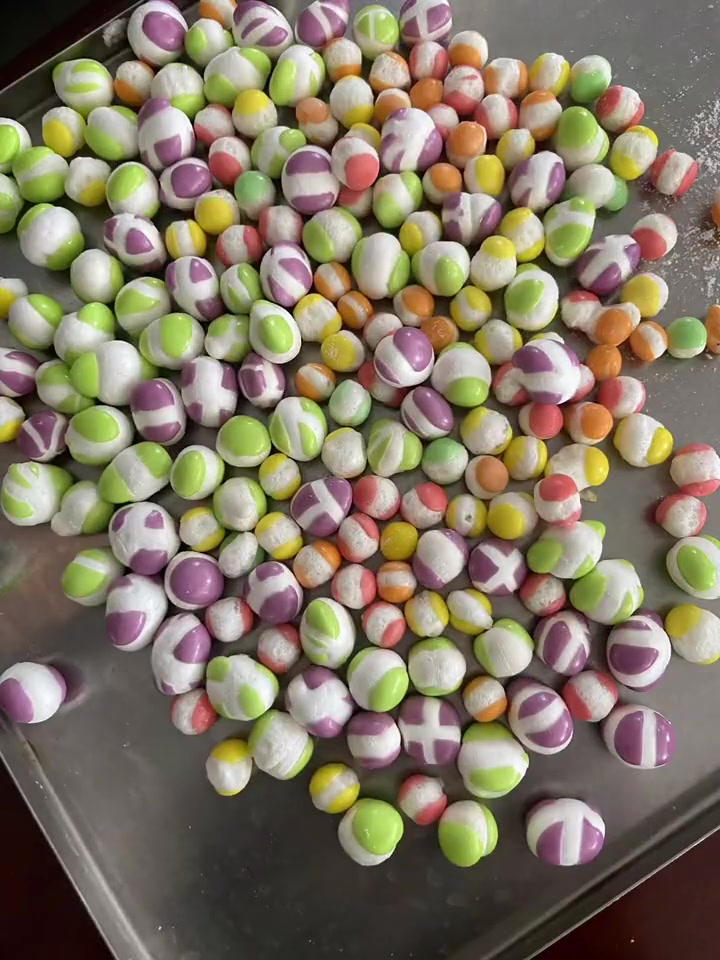
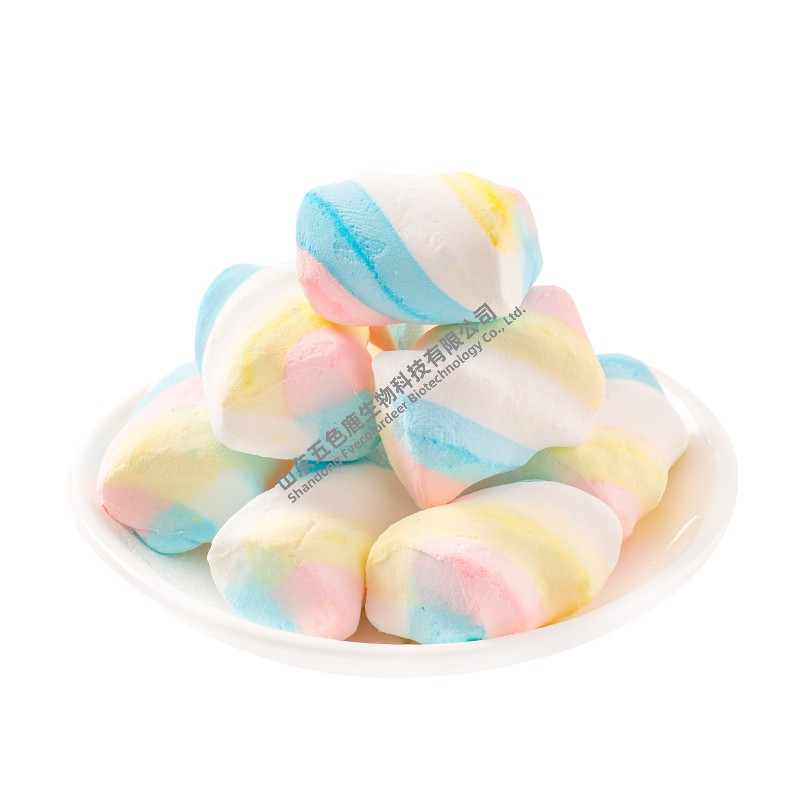
Getting freezedried candy right is arguably one of the most difficult operations. High sugar content in the candy will significantly lower the freezing point resulting in an unfrozen, sticky, and soft substance. If, however, the parameters such as vacuum, temperature, or drying time aren't appropriately balanced to the candy type, it might lead to the candy expanding nonuniformly, collapsing, or being merged to one mass.
And so we get: uneven product quality, fused non-sellable candy, and a 15–20% loss per batch.
Each candy change requires different parameters which is another problem. Gummy bears, cotton candy, rock candy, hard candies, and soft coated sweets will be all different, each needing a different heat level and vacuum setting.
If parameter change is difficult, it will lead to a long time running a test batch before stabilization, thereby delaying production and keeping the equipment idle.
What we Offer
We have developed the FDG series for industrial-scale candy freeze-drying that you rely on without guesswork.
The PLC system can hold up to a hundred different validated recipes. You can go from candy-coated fruit slices to gummy bears instantly with identical reliable performance.
With PID-controlled independent shelf heating, temperature fluctuation between the layers is kept to a minimum. Vacuum pressure and the uniformity of the sublimation front are maintained thanks to that. These measures prevent both the candy from collapsing and from having an inconsistent texture of one layer relative to another.
Detailed production results from the most effective operation schemes:
Yield rate: ≥97% of the batch maintains intact shape, uniform texture, and meets visual quality standards (no fusion, collapse, or discoloration).
Candy production run: 18–24 hrs
Moisture in the candy: ≤3%
Moisture difference between trays: ±0.5%
Short changeovers and minimum operator intervention lead to less equipment downtime, reduced labor hours and higher equipment availability.
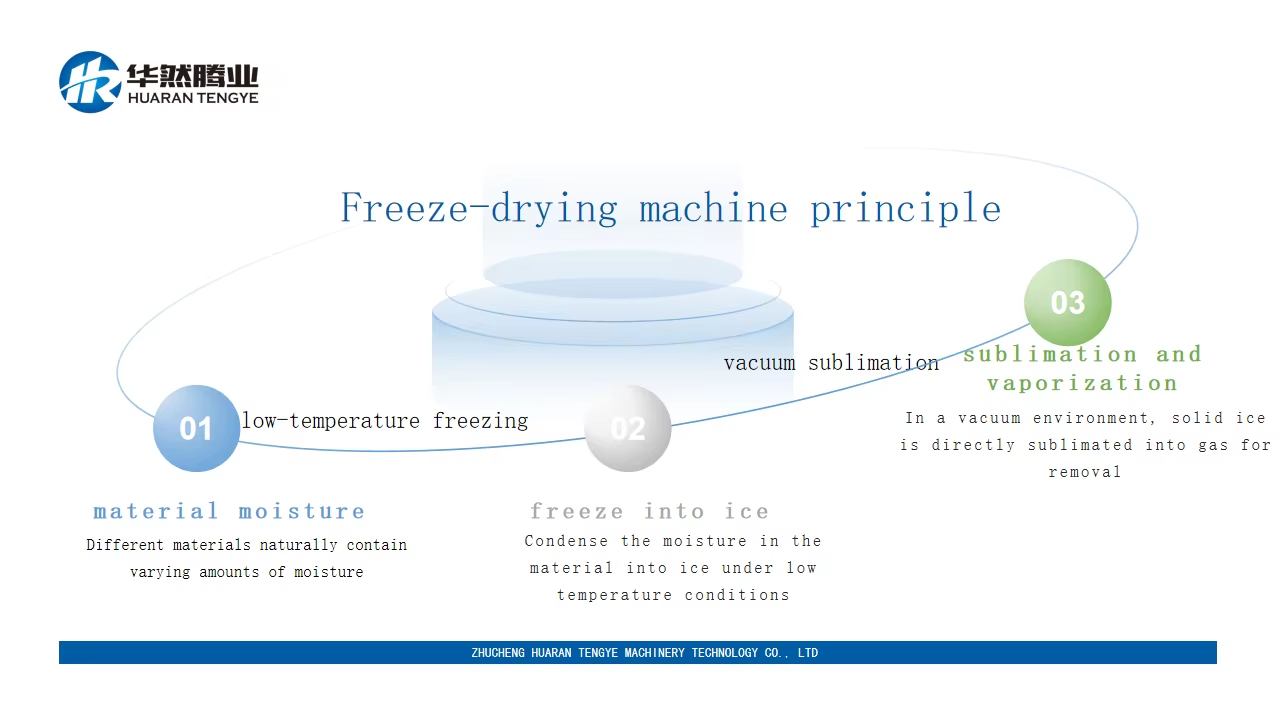
| Parameter | Specification | Industry Benchmark |
| Ultimate vacuum pressure | ≤5 Pa (achievable) | ≤10 Pa (typical industry range) |
| Operating vacuum range | 10–50 Pa (sublimation phase) | Standard range |
| Shelf temperature range | -45°C to +80°C | Standard |
| Cold trap temperature | ≤ -65°C | ≤ -60°C (standard) |
| Final product moisture | ≤3% (typical) | ≤5% for most food products |
| Freezing rate | 1–3°C/min (adjustable) | Controlled-rate freezing |
| Defrost method | Hot water circulation | Electric/hot gas/water (varies) |
Keep in mind that actual results may vary slightly from the design values due to differences in processing method, loading, and handling procedures.
The following information pertains only to candy products: Candy contains a dramatically lower starting water content (usually 5%–20%) compared to fruits (which have water contents between 80%–90%), so the output dry weight in candy processing is going to be substantially higher. For instance, 500 kg of gummy candy as the input may produce freeze-dried output amounting to about 450–475 kg. The final product will be subject to a little variation based on the recipe.
Do not hesitate and let us know if you need to establish a yield for your specific product - we can help you estimate the product yield.
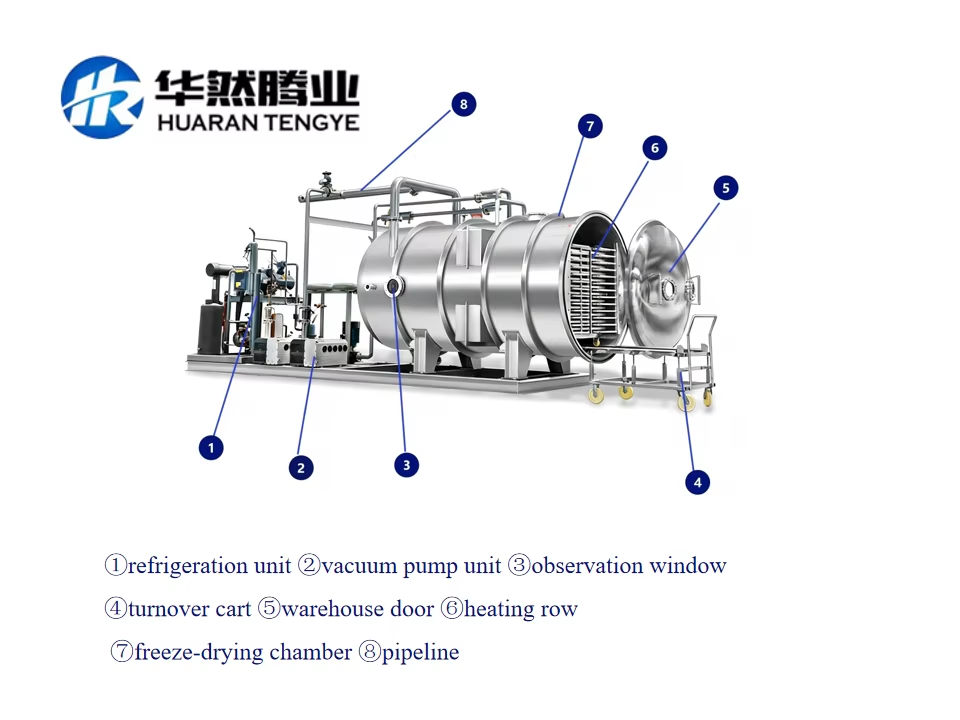
| Model | Shelf Area (m²) | Batch Capacity (kg/cycle)* | Recommended Product Type |
| FDG-0.5 | 0.5 | 5 | R&D / pilot batches |
| FDG-1 | 1 | 10 | Small-batch premium candy |
| FDG-5 | 5 | 50 | Small-scale production |
| FDG-10 | 10 | 100 | Commercial production entry |
| FDG-20 | 20 | 200 | Mid-scale production |
| FDG-30 | 30 | 300 | Full-scale production |
| FDG-50 | 50 | 500 | Large-scale operation |
| FDG-75 | 75 | 750 | Industrial production |
| FDG-100 | 100 | 1,000 | High-volume production |
| FDG-125 | 125 | 1,250 | Industrial scale |
| FDG-150 | 150 | 1,500 | Large industrial line |
| FDG-200 | 200 | 2,000 | Maximum capacity |
Capacity based on water content of typical fruit materials (approx. 80-90% initial moisture). Actual yield varies by product formulation and loading density.
Custom configurations available for non-standard shelf areas or special material handling requirements.
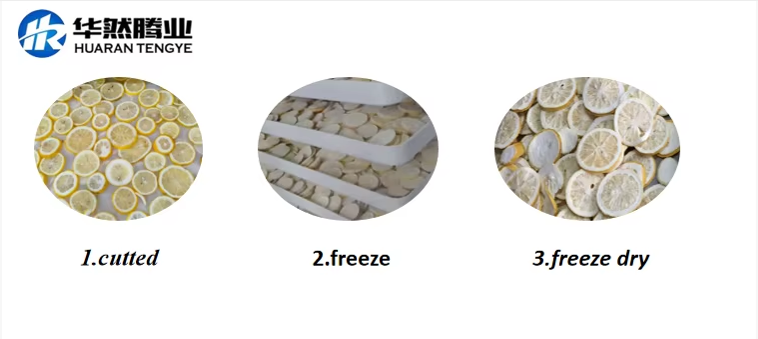
System Configuration
C old storage system:
Compressor:
Bitzer (Germany) compressor or equivalent open type semi-hermetic compressor.
Refrigerant: R404A / R507 (regulations will be the main determining factor)
Cooling method options: Water-cooled / air-cooled (choice will be made at the time when the purchase is ordered)
V acuum system:
Method: two-stage rotary vane pump and roots pump
Pump supplier: Leybold, Edwards or a manufacturer with a quality matching Tier1 Chinese
Highest allowed vacuum level:under 5 Pa
Rate of air leakage:<10 Pa·L/s
Control system: PLC: Siemens S7-1200 series
Touch screen: HMI 10" Siemens or WEINVIEW
Door: door with hinges, a silicone gasket, and a soft seal which opens with a soft seal to a sealed vacuum door
The reasons why candy freeze-drying is different
Compared to fruit, candy's higher sugar content results in some different issues:
Lower eutectic point: It needs much colder pre-freezing (-40°C to -50°C) to be fully solidified
Viscosity risks: In the first stage of drying, partially melted sugar can get sticky which causes merging together
Slow sublimation: Moisture is trapped more tightly within sugar matrices which necessitates longer secondary drying
Our FDG series tackles these problem areas as follows:
Fast, well-frozen uniform freezing (1-3°C/min, changeable) to make sugar structure stable
Temperature control via PID shelf heating to avoid sugar melting caused by sudden temperature increase
Moisture content monitoring system that can keep ≤3% moisture even without over-drying
Founded: 2006 (with 19 years in the industry)
Factory size: 18,000 m²
R&D team: 22 engineers
Production lines: 4 assembly lines
Annual capacity: 120+ units/year
Certifications: ISO 9001, ISO 14001, CE, ASME
Component cooperation: Bitzer, Leybold/Edwards, Siemens, Emerson
Export countries: over 40, including the USA, Germany, Japan, South Korea, Australia, Brazil
Number of equipment delivered since 2010: more than 800
| Item | Detail |
| Standard lead time | 45 working days from order confirmation (models up to FDG-50) |
| Large models (FDG-75+) | 60–75 working days |
| Installation & commissioning | On-site support available (additional cost, travel expenses separate) |
| Spare parts availability | 48-hour dispatch for critical components |
We can provide engineering changes for the following:
Spacing of special shelves (for thicker items or loading in bulk)
CIP system interfacing
Nitrogen filling for oxidizable products
Finish compatible with GMP guidelines for pharmaceutical-grade applications
Explosion-proof setup for materials containing solvents
Procurement Information
To request a formal quotation:
Specify the target product type and formulation.
Indicate the batch size in kg.
Demand product dimensions: max thickness / particle size.
List of utilities available: main electricity supply (voltage/amps, phase), cooling water temp, air compressor.
List of certifications necessary: CE, ASME, GMP, etc.
Quotations are valid for 30 days from the date of issue. For projects with longer planning horizons, we are happy to review and extend the validity upon request.
1. What is the delivery lead time?
45 business days for FDG-0.5 up to FDG-50; 60 - 75 days for FDG-75 and higher. Excludes shipping.
2. Do you assist with equipment installation?
We do. On-site commissioning, test runs with your materials and operator training are included in our services. Travel costs are paid separately. There is also a remote video support option.
3. What is the warranty period?
12 months from commissioning.
Critical spare parts will be sent within 48 hours. There are options for extended warranty and maintenance services.
4. Can I make changes as per my preference?
Of course! We'll custom make you the shelves just the way you wish, integrate CIP, install a nitrogen backfill system, ensure the final product is GMP compliant and also make the whole unit explosion-proof if needed. Kindly let us know the specifications.
5. May high-sugar candy be damaged in terms of sugar content when the freeze-drying process is carried out?
A: Our FDG series has PID control and gradual heating cold stage of freeze-drying is done while temperature monitoring of the product and the system can detect the product’s real-time temperature and modify the shelf heating so that it can be ensured the candy remains under its collapse temperature during the entire process.
6. Can the same machine be able to produce both gummy bears and rock candies?
A: Most definitely. The PLC memory can hold up to 100 confirmed recipes you can change the machine's setting of making gummy bears (at a lower temperature, over a long period) to producing rock candy (at a higher temperature, for a short duration) just with a choice of a recipe - no manual setting changes are required!
7. What about the average yield of candies?
A: Normally most candies have a shape retention rate greater than 97% with only around 3% being lost through merging or collapsing or surface defects.





