Product Introduction
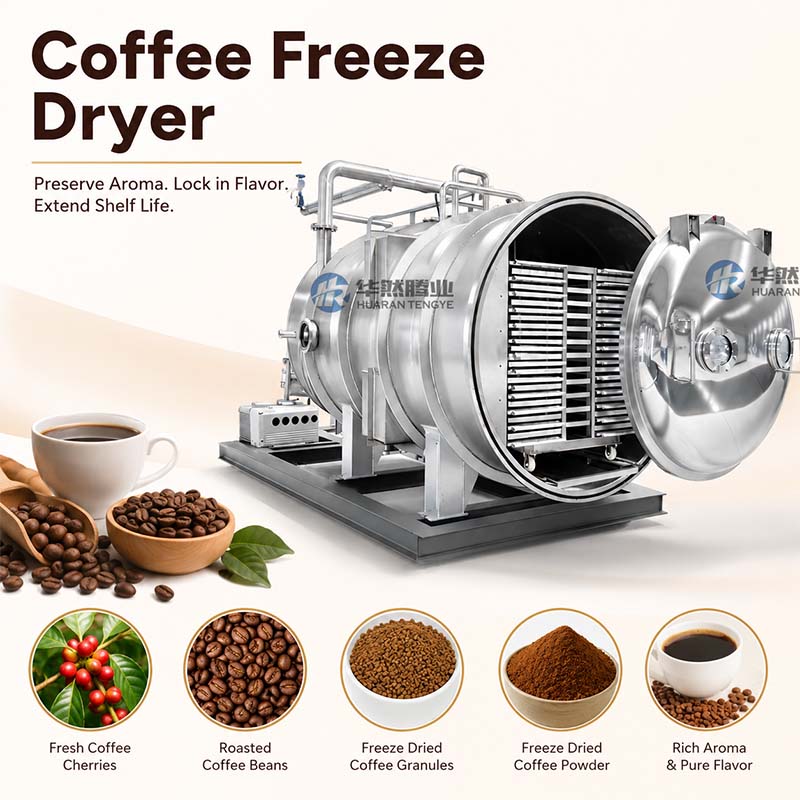
Coffee freeze-drying is a highly challenging process. The roasted beans are very dense and also oil-rich, so moisture doesn't escape evenly - the surface layer dries quickly while the inner part remains moist. Oils that naturally occur and sugars remaining in the coffee can lower the freezing point, which causes the tissues to become soft or collapse entirely if vacuum and heat input from above are not perfectly timed.
An error could result in small, dark-colored beans; it would also remove aroma compounds by evaporation, thus leaving behind stale, flat-tasting coffee - in any case, at least 10-15% of the batch will be a loss.
The result would be - brittle beans; weak crema; and a cup that has barely any flavor. Such coffee could never really be mistaken for high-quality instant coffee.
Type of beans and roasting level make the process even more complicated. Arabica as against Robusta beans; light as compared to dark roast; whole beans, coarse ground, and fine grounds - these vary with respect to oil content, sugar, and density, and therefore, every bean variety needs a different freezing curve and a different sublimation profile to be set. Failing proper logging of these parameters, operators end up doing their trials throughout the day, which results in delays in packaging and reduction of production time.
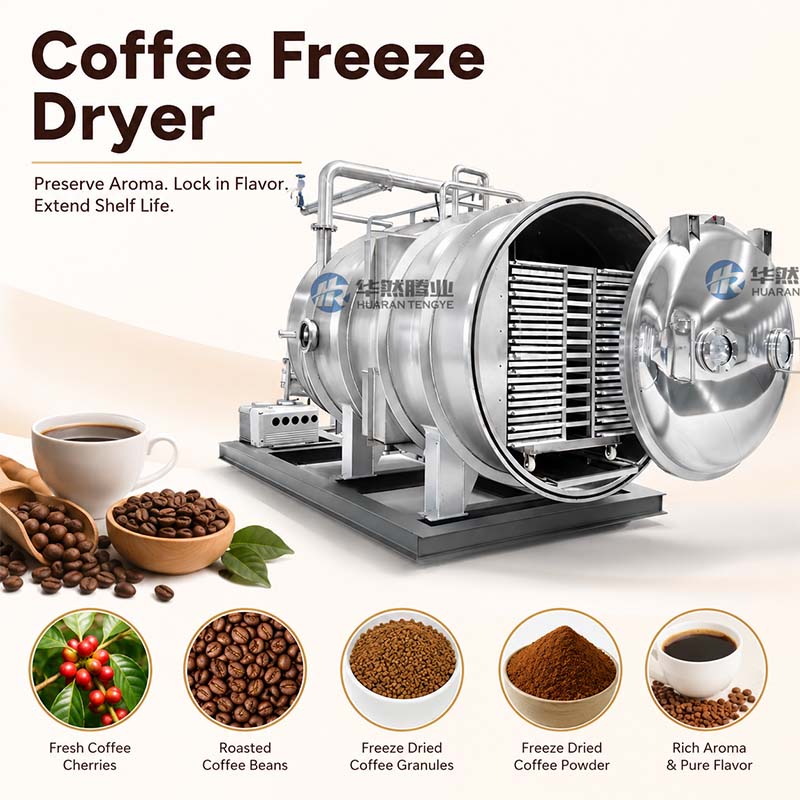
Our SolutionThe FDG Series is built exactly for lyophilizing coffee without any sacrifice to the quality or volume. There's only fruit-drying as an option left when it comes to compromise.
The PLC is a unit that can take hundreds of coffee programs from different areas of the world that have already been tried in the field and which reflect not only the common varieties and roasting but also the different particle formats and moisture targets.
If you only want to start from one Arabica whole bean line and end up with ground Robusta, it is possible to do in just several minutes – and you still get the same golden-brown color and the same freshness and delicacy of flavor.
PID regulation of the shelf plates independently prevents thermal drift, and the vacuum fluctuation that causes uneven vapor extraction from the surface to the core of the dried material is also minimized thanks to the vacuum modulation, which is done in a stable way so that the volatile aroma can be well preserved.
Here is how it will look in production with running programs and being adjusted to the situation:
The product recovery after the drying process: ≥95%
Drying time per batch (whole beans): 20–28 hours
Moisture after drying process: below 3%
Mechanical drying method that results in variation of final moisture content between batches: ±0.5%
Able to go fast between varieties and grind sizes and, at the same time, with minimal operator supervision, gives the maximum productivity, less expenditure for labor, and higher profitability of production by investing in equipment.
Core Technical Parameters
| Parameter | Specification | Industry Benchmark |
| Ultimate vacuum pressure | ≤5 Pa (achievable) | ≤10 Pa (typical industry range) |
| Operating vacuum range | 10–50 Pa (sublimation phase) | Standard range |
| Shelf temperature range | -45°C to +80°C | Standard |
| Cold trap temperature | ≤ -65°C | ≤ -60°C (standard) |
| Final product moisture | ≤3% (typical) | ≤5% for most food products |
| Freezing rate | 1–3°C/min (adjustable) | Controlled-rate freezing |
| Defrost method | Hot water circulation | Electric/hot gas/water (varies) |
All figures reflect design-phase engineering targets. Product output depends on factors such as biomass characteristics, pile arrangements, and operation performance.
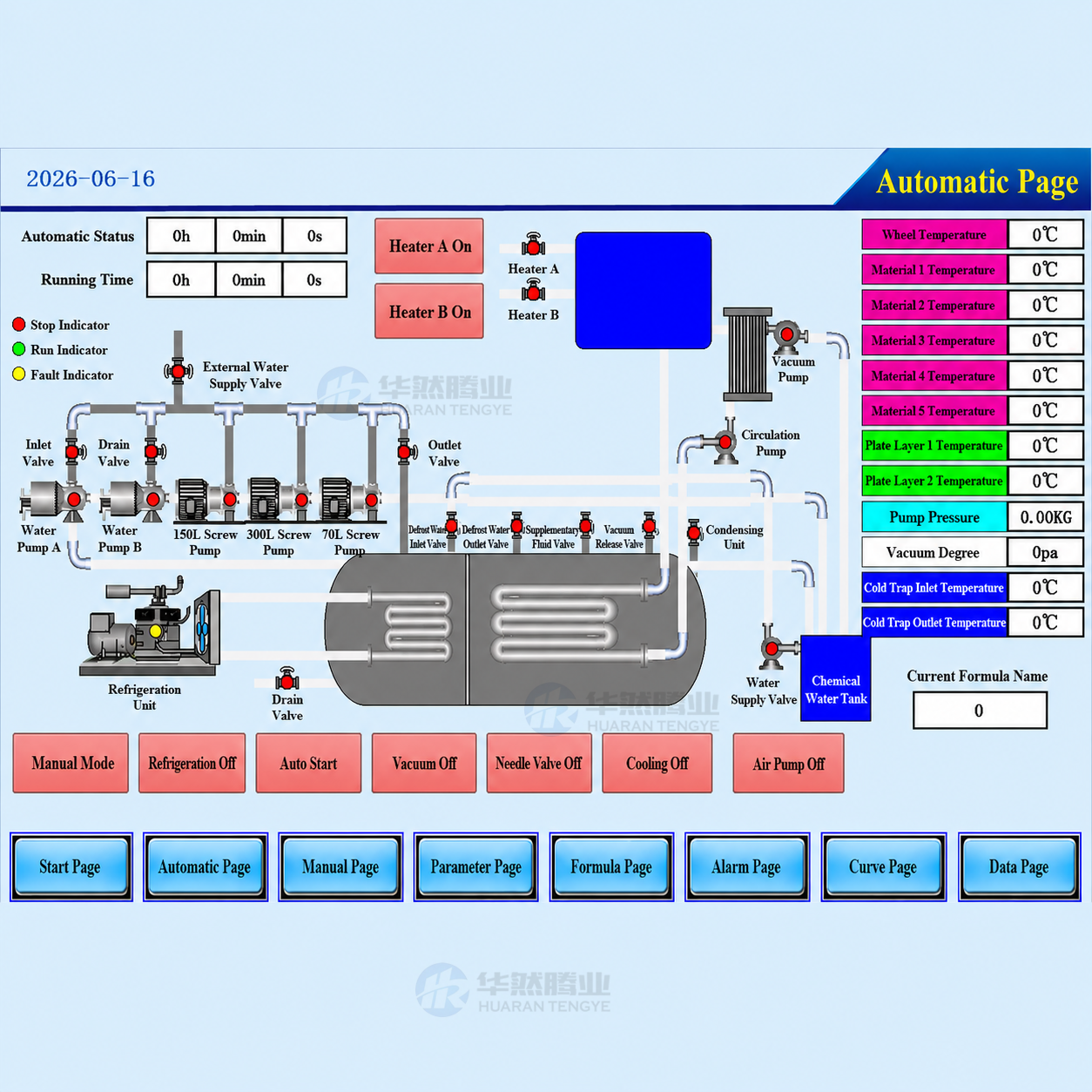
Model & Capacity Range
| Model | Shelf Area (m²) | Batch Capacity (kg/cycle)* | Recommended Product Type |
| FDG-0.5 | 0.5 | 5 | R&D / pilot batches |
| FDG-1 | 1 | 10 | Small-batch specialty coffee |
| FDG-5 | 5 | 50 | Small-scale production |
| FDG-10 | 10 | 100 | Commercial production entry |
| FDG-20 | 20 | 200 | Mid-scale production |
| FDG-30 | 30 | 300 | Full-scale production |
| FDG-50 | 50 | 500 | Large-scale operation |
| FDG-75 | 75 | 750 | Industrial production |
| FDG-100 | 100 | 1,000 | High-volume production |
| FDG-125 | 125 | 1,250 | Industrial scale |
| FDG-150 | 150 | 1,500 | Large industrial line |
| FDG-200 | 200 | 2,000 | Maximum capacity |
Capacity based on coffee concentrate with 40–50% solids content (typical for freeze-dried coffee production). The real yield per cycle changes based on the level of the product in the concentrate, how thick the layer is, and how the system is set up. The final weight that can be produced by one batch is going to come from a combination of factors of bean density, degree of roasting, particle size, and chamber packing; for any non-standard processes, bespoke shelves and holding devices are made available.
System Configuration
Vacuum subsystem:
The two-stage vacuum pump includes an oil-free vane stage plus a Roots booster, thereby enabling two-level extraction.
Manufacturers: Leybold / Edwards / premium domestic equivalent
The deepest vacuum which can be reached at floor level is: ≤5 Pa
The maximum allowable leakage is: ≤10 Pa·L/s as the manufacturer’s test result shows
AUTOMATION CONTROL:
Main control unit: Siemens S7-1200 PLC
Display: 10-inch LCD monitor (Siemens / WEINVIEW)
Data logging: Temperature, pressure, and cycle status are continuously recorded and can be exported via USB or LAN
Operation modes: Full recipe-triggered operation / manual mode
CHAMBER:
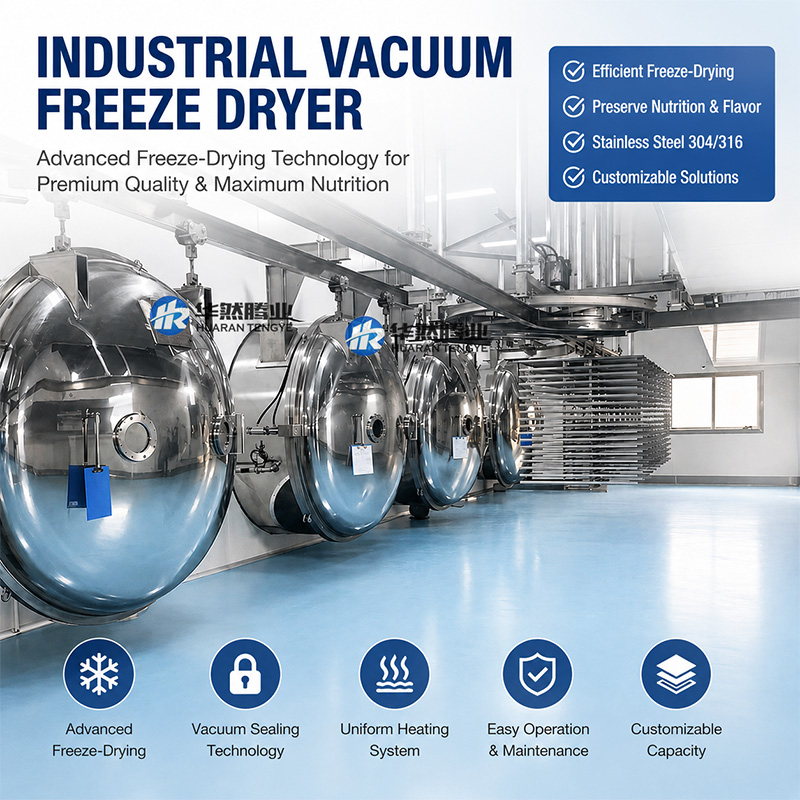
Casing: vacuum-proof SUS304 stainless steel of food-contact-grade standard
Interior surface: mirror polish (Ra ≤0.8 μm) — coffee sugars are less likely to caramalize and the buildup of coffee oil is limited so it becomes easier to clean.
Outer surface finish: brushed or coated (to be decided at a later stage)
Twin vacuum-tight and soft-motion doors, silicone sealed.
Operational Process
FDG series coffee freeze-drying consists of three main stages:
① Freezing stage: By cooling the beans at a rate of 0.5-1.5°C/min, the temperature is brought down until it reaches the supercooled range of -38°C up to -45°C. The gradual lowering of temperature gives the formation of micro-ice crystals without destroying the cell structure of the bean. Regular drying takes a period of 3–8 hours based on the size, oil and sugar content, and fill weight of the beans.
② Sublimation stage: At first, chamber vacuum is brought between 10 and 60 Pa, and then shelves are heated by PID to -5°C in steps in case of different drying loads. The sublimated vapor is condensed by the condenser working at a temperature range of -55°C to -70°C. An average drying operation runs 12–22 hrs based on bean density and particle size.
③ Desorption stage: The beans are held at a temperature between 45 and 55°C, and while the vacuum is kept below 10 Pa, the heat causes the removal of the moisture that is remaining from the densely packed, oil-rich coffee matrix. The beans have a final moisture level of ≤3%, and the 3–8-hour process prevents the emergence of dull color and off-flavors. Total drying time: ~18–28 hours for whole beans, 22–32 hours for ground coffee and denser formats.
About UsFounded: 2006 (with 19 years in the industry)
Factory size: 18,000 m²
R&D team: 22 engineers
Production lines: 4 assembly lines
Annual capacity: 120+ units/year
Certifications: ISO 9001, ISO 14001, CE, ASME
Component cooperation: Bitzer, Leybold/Edwards, Siemens, Emerson
Export countries: over 40, including the USA, Germany, Japan, South Korea,
Australia, Brazil
Number of equipment delivered since 2010: more than 800
Production & Delivery
| Item | Detail |
| Standard lead time | 45 working days from order confirmation (models up to FDG-50) |
| Large models (FDG-75+) | 45–60 working days |
| Installation & commissioning | On-site support available (additional cost, travel expenses separate) |
| Spare parts availability | 48-hour dispatch for critical components |
Design Customization Options
Engineering adaptations that are especially good for coffee processing include:
Larger areas of coffee storage to allow for different forms of beans like whole beans, coarse/fine grounds, and granules
CIP-water spraying that combines cleaning of oily and sugary residue after the chamber is batch-processed
Gas-filled with nitrogen that traps volatile aromas and prevents the degradation of oils after drying
Finished product of the food-hygienic GMP standard suitable for quality-controlled and certified coffee processing plants that meet international standards
Flavor coatings with carrier solvents process that is done with electric systems that are resistant to explosion
Perforated trays that allow vapor and CO₂ to escape from a tight bean pack, speeding up the evaporation
If you're interested, please get in touch with us by providing the following details so that we can give you a quote:
Details about coffee (kind of bean / roast level / particle size)
Production capacity (kg per batch, per day, number of batches)
Raw material form (green or roasted, moisture content, etc.)
Factory utilities (voltage / current type, chilled water temperature, compressed air supply)
The quoted price remains valid for 30 days after it has been submitted to you; an increase in specifications or changes in them will necessitate a new quote after your technical finalisation.
FAQ
1. How is the vacuum pump of the equipment prevented from getting dirty with coffee oil? The use of a large-sized trap, a cold trap set to -55°C to -70°C that captures both water vapors and volatile oils and aroma components that are released from the roasted beans, protects the pump and maintains vacuum integrity even as different batches keep coming in and out.
2. Will the freeze-dried coffee beans still smell of their rich aroma and keep their golden-brown color? Absolutely. By using PID controlled gentle shelf heating, no thermal damage is done to the natural pigments and the volatile aroma compounds. However, for the highest quality, you need to add the optional nitrogen refill, which prevents the ingress of oxygen at the point of packaging and keeps the products in good shape.
3. Can the machine be employed to process both whole beans and fine grounds? Definitely. The PLC (Programmable logic Controller) remembers 100 already tested recipes, the freezing time, vacuum level, and drying process. Changing from whole beans to fine grounds merely involves a few minutes of preparation, and each batch will have the same quality product.
4. Freeze-drying - whole beans vs ground coffee How is one different from the other?
Whole beans require much longer periods - a dense, oil-rich matrix slows vapor migration - about 20–28 hours. Ground coffee gives up the moisture quicker, about 16–25 hours. Processes for both types have already been optimized and set in the recipe files.
5. What is the standard time for production?
45 working days for standard models (FDG-CF-0.5 to FDG-CF-50); 45–60 working days for large models (FDG-CF-75 and above). Shipping time not included. Custom configurations may require extended lead time — consult our team for specific timelines.
6. Installation and after-sales service?
We do have that. The service range is from on-site commissioning, trial runs with samples supplied by your company, and operator training. You are also welcome for remote-assisted video startup. The warranty includes 12 months from commencement, and urgent replacement parts will arrive in 48 hours at the most. It is on request that extended service agreements and preventive maintenance visits will be made available.