Product introduction
Lyophilisation of whole freeze-dried quail is difficult because you have multiple bird parts, each one reacting differently during the drying step. The bird’s body cavity that holds the moisture is another reason besides the fact that the drying must be done in combination of skin, muscles, and bones without any bone breakage. The skin is quite easy to dry, while the muscle is harder and takes more time, and the bone is hardest to work with but needs the least time for it to dry, which is interesting, but if these layers aren’t accounted for by ramp rates, vacuum depth, and hold times, cracking of skins, hollowing of body cavities, or the presence of wet layers near bones may result, leading to 12–18% losses.
The birds will be physically damaged, bone-in parts will only last a short time, and the rejects cannot be used again.
Freezing is done correctly only when taking size into consideration; the size of quails can vary from as large as a quail egg weighing 250-300 g down to 120-150 g of a normal quail.
Operators have to make lots of constant adjustments without preset formulas so that their operation becomes a rather inefficient mode that will slow down a frozen food production line during the packaging, as well as not save the storage capacity of a frozen foods production line.
Our Solution
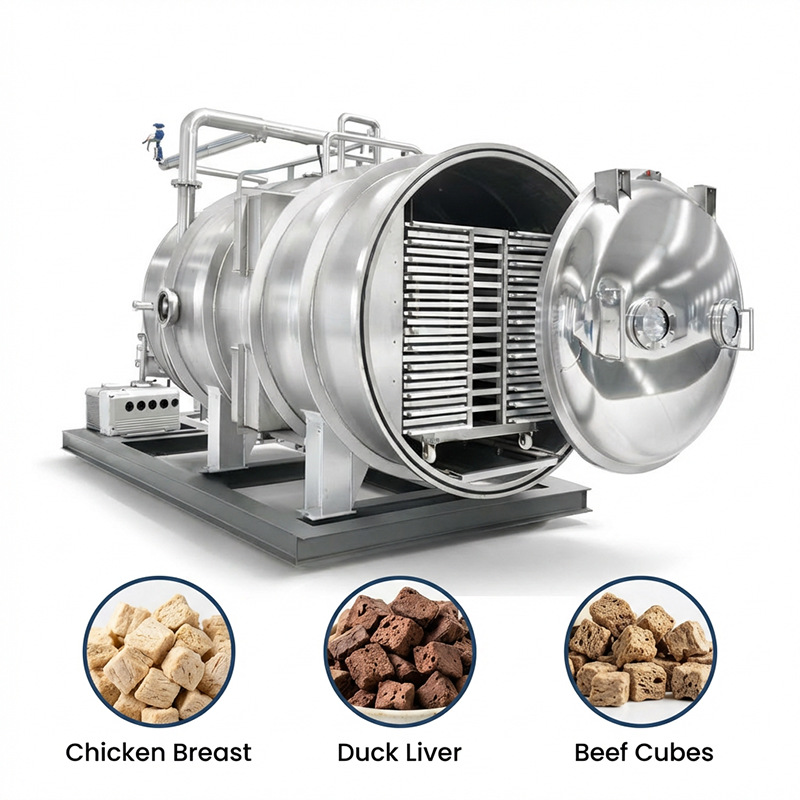
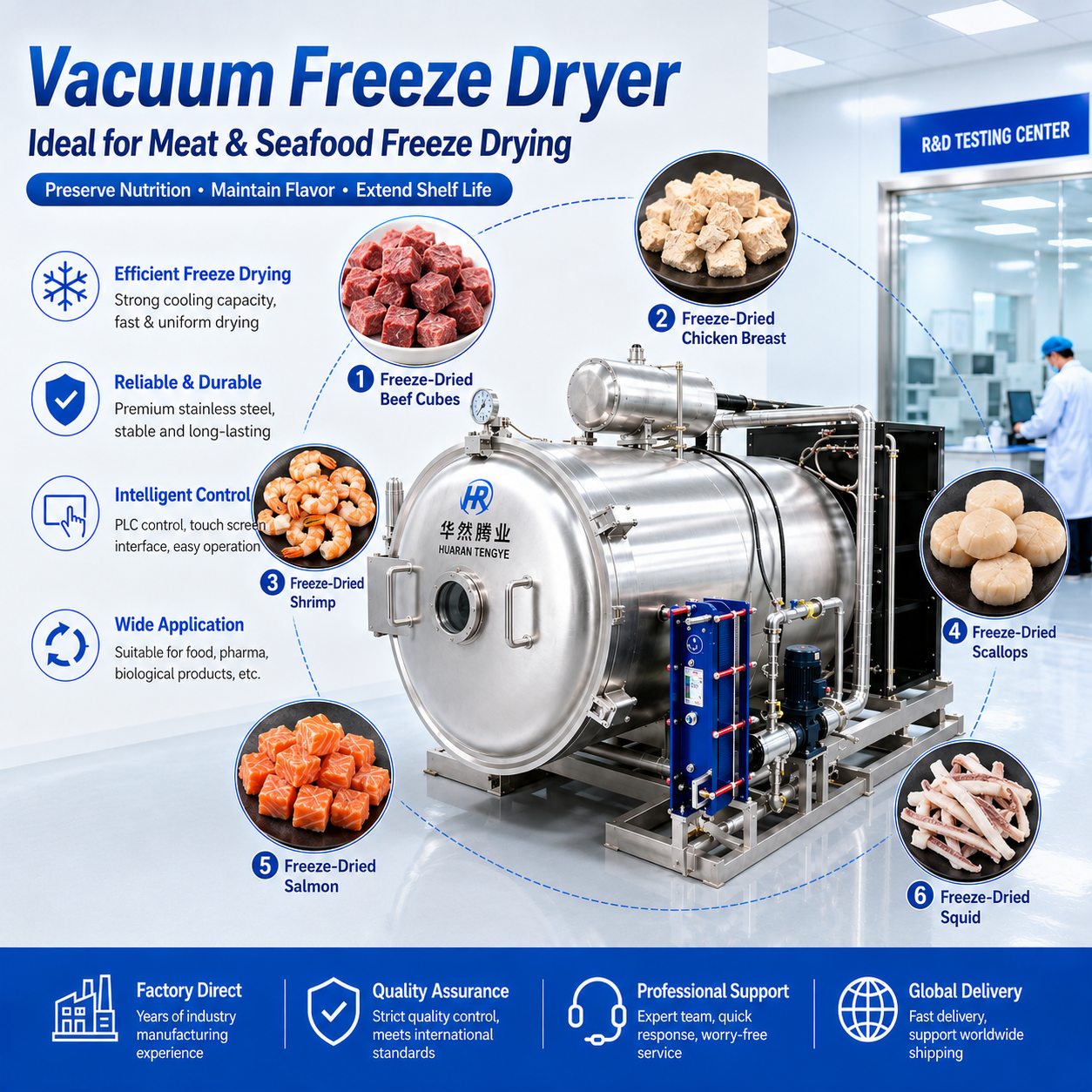
FDG Series is made especially for lyophilizing large amount of quails without losing their texture and flavor; it's not a generic drying system.
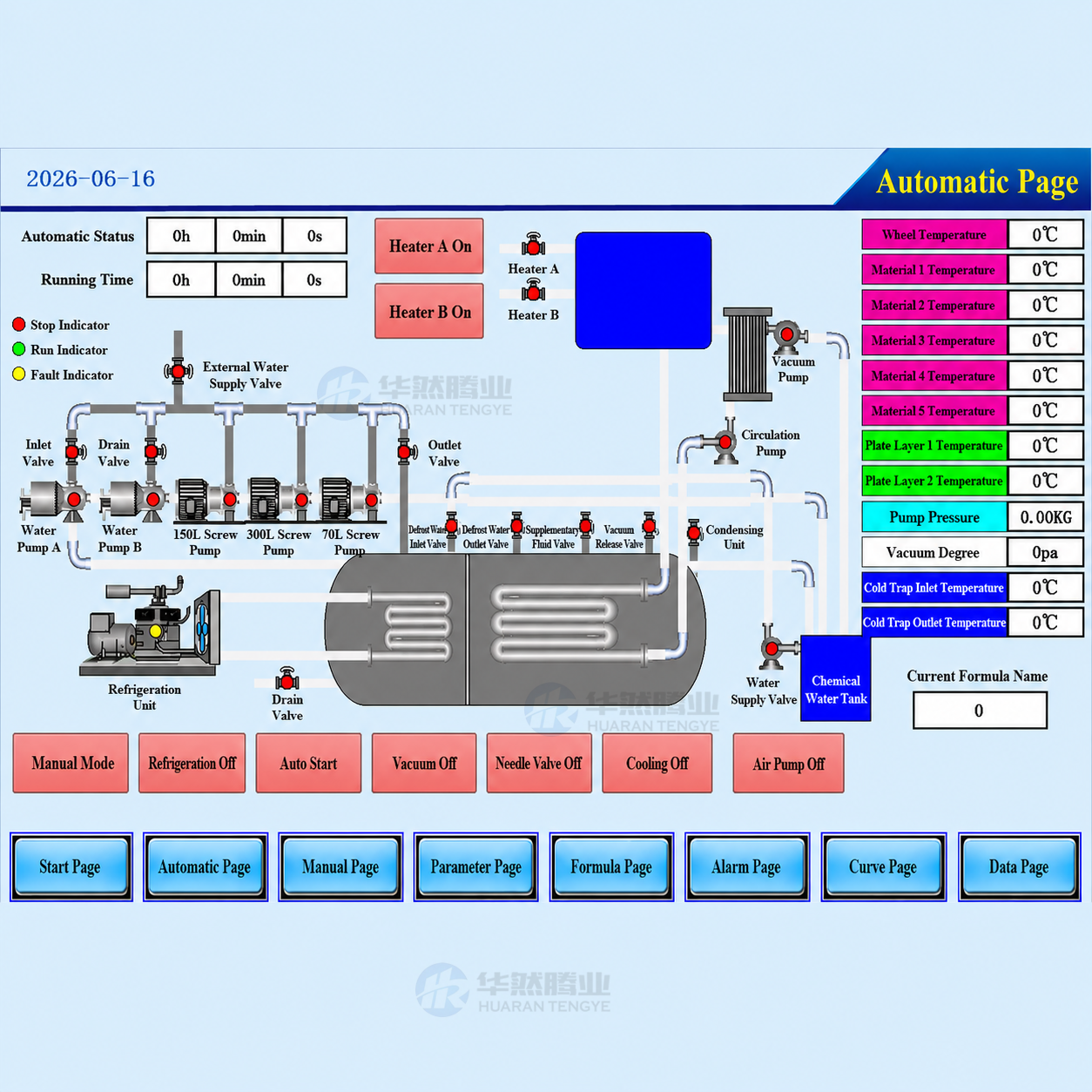
You will be able to store up to 100 different recipes of quails inside the micro-programmable controller and run almost any program that you want. With a wide range of bird sizes, egg types, and finished product moisture levels, it's just a matter of having them in your head first.
We have a changeover within the machine, from large whole quails to egg trays, and the same level of reliability product in each operation. It’s surprising to see how quickly things can change in such a short time!
No difference in temperature across shelves is possible with an independent PID control system. Furthermore, controlled vacuum is used so that there is no difference in vapor removal between different birds in that room. This is why there is no splitting, skin or skin pocket, bone or bone water pockets, and body to body differences.
We are giving below our production results when the settings were optimized:
Finished product yield: greater than or equal to 95%
Production time per batch (whole quail): ranging between 24 and 36 hours
Final moisture content: less than 3%
Moisture variation among different trays: 0.5% up or down
Quick changeover from one type to another and reduced manual labor leads to not only lower total time but also savings in labor cost and extra hours of work per day.
| Parameter | Specification | Industry Benchmark |
| Ultimate vacuum pressure | ≤5 Pa (achievable) | ≤10 Pa (typical industry range) |
| Operating vacuum range | 10–50 Pa (sublimation phase) | Standard range |
| Shelf temperature range | -45°C to +80°C | Standard |
| Cold trap temperature | ≤ -65°C | ≤ -60°C (standard) |
| Final product moisture | ≤3% (typical) | ≤5% for most food products |
| Freezing rate | 1–3°C/min (adjustable) | Controlled-rate freezing |
| Defrost method | Hot water circulation | Electric/hot gas/water (varies) |
Note:
Figures quoted are engineering reference points. Actual yield depends on ingredient profile, chamber loading approach, and shop-floor operation standards.
| Model | Shelf Area (m²) | Batch Capacity (kg/cycle)* | Recommended Product Type |
| FDG-0.5 | 0.5 | 5 | R&D / pilot batches |
| FDG-1 | 1 | 10 | Small-batch poultry/pet treat |
| FDG-5 | 5 | 50 | Small-scale production |
| FDG-10 | 10 | 100 | Commercial production entry |
| FDG-20 | 20 | 200 | Mid-scale production |
| FDG-30 | 30 | 300 | Full-scale production |
| FDG-50 | 50 | 500 | Large-scale operation |
| FDG-75 | 75 | 750 | Industrial production |
| FDG-100 | 100 | 1,000 | High-volume production |
| FDG-125 | 125 | 1,250 | Industrial scale |
| FDG-150 | 150 | 1,500 | Large industrial line |
| FDG-200 | 200 | 2,000 | Maximum capacity |
Short version:
This capacity is calculated based on whole quail with about 65 to 75% moisture content - the real result will differ with the bird type and how full your trays and recipe are.
Drying capacity is influenced by recipe details & fill level of trays. For unconventional needs, unique shelf dimensions and special loaders are available through customization.
Quality & Compliance
The pressure boundary standard can be ASME or GB150, as applicable. However, it is recommended to confirm the regulation to comply with at the purchase stage.
Electrical code conformity: either by the CE route (optional) or according to the Chinese national requirements
Pre-exit inspection: All vessels will go through hydrostatic and helium vacuum decay tests before they are released
Main component guarantee period: 12 months from the date of operational handover
Pre-delivery witnessing test: The FAT (Factory Acceptance Test) will be arranged if the buyer requests.
Production & Delivery
| Item | Detail |
| Routine build schedule | 45 working days post-order (FDG-0.5 to FDG-50 range) |
| High-tonnage models (FDG-75+) | 60–75 working days |
| Field installation and training | Available as a charged service (travel costs quoted separately) |
| Emergency replacement parts | 48-hour air dispatch |
Design Customization Options
Our engineering department specializes in tailoring our machines to your requirements by:
Widening the space between shelves to fit trays of whole quails, bone-in loads, and over sized carcuss
Designing a clean-in-place washing down circuitry is a must for raw poultry hygienic protocols
Bird's skin is prevented from turning rancid by using an atmosphere of nitrogen, which also increases the shelf life after packaging.
GMP-grade hygiene finish, backed up by validation documents, for export-oriented facilities
Electrical classification for hazardous areas for the use of solvents in aroma-infusion and flavor-coating operations
Machines with semi-automated tray or rack loading features suitable for continuous fast-running quail lines
Equipment that has logging of batches and traceability as a feature of the HACCP system
Procurement Details
In case of interest in obtaining a quotation, we invite you to kindly provide the information below:
Description of the product category & recipe details (e.g., whole quail, split carcass, egg, seasoned version)
Production capacity needed (kg per batch)
Raw material specifications (max bird weight, bone-in or deboned, inclusion of eggs)
Facility services details (main voltage & phase, cooling water supply temperature, compressed air pressure, etc.)
Legally required safety markings (CE, ASME, GMP, HACCP, etc.)
If the quote has been made based on the data provided, it shall be valid until one month from the issue date. Besides, the quotation is subject to change, with the final engineering decision being the trigger factor.
FAQ
1. How long does production take? FDG-0.5 to FDG-50: 45 calendar days. FDG-75 and above: 60–75 calendar days. Transportation of goods by sea or air is excluded.
2. Will you assist us with installation and operator training? Yes, of course. We organize on-site commissioning, product trials with your genuine feed material, and operator training covering all technical aspects. Expenses connected with travel have to be handled separately and charged separately. Live remote assistance for initial operation is also available to help with any queries.
3. What are the conditions of your warranty? The period will begin 12 months from the date of commissioning, during which we guarantee the equipment and technical assistance. Urgent replacement parts will be delivered to you by fast delivery within 48 hours. In addition, we are offering optional extended warranty contracts together with preventive maintenance services.
4. Is there a possibility to fit the system to our specifications?” Absolutely! Changes are usually made, such as making the clearances on the shelves larger to be able to load the whole birds, introducing an automated CIP wash system, adding nitrogen backfill, having a hygienic and smooth working environment by applying GMP finish, and meeting explosion-proof standards. Send us your detailed technical requirements to receive a feasibility evaluation from our engineers.