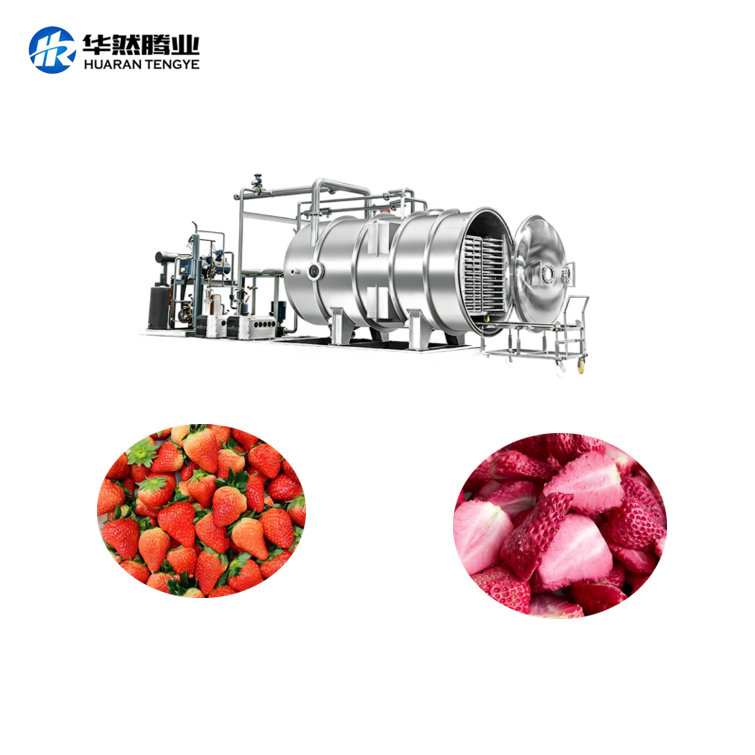
Customer Pain Points+Our Solution
In addition to the issues with long drying time and large energy consumption, strawberries undergoing freeze-drying are sometimes dried unevenly, changing the color and shape of the strawberry and affecting the product consistency. The production can be affected if such a manual operation is done on a large scale and is a factor of reduction in overall production.
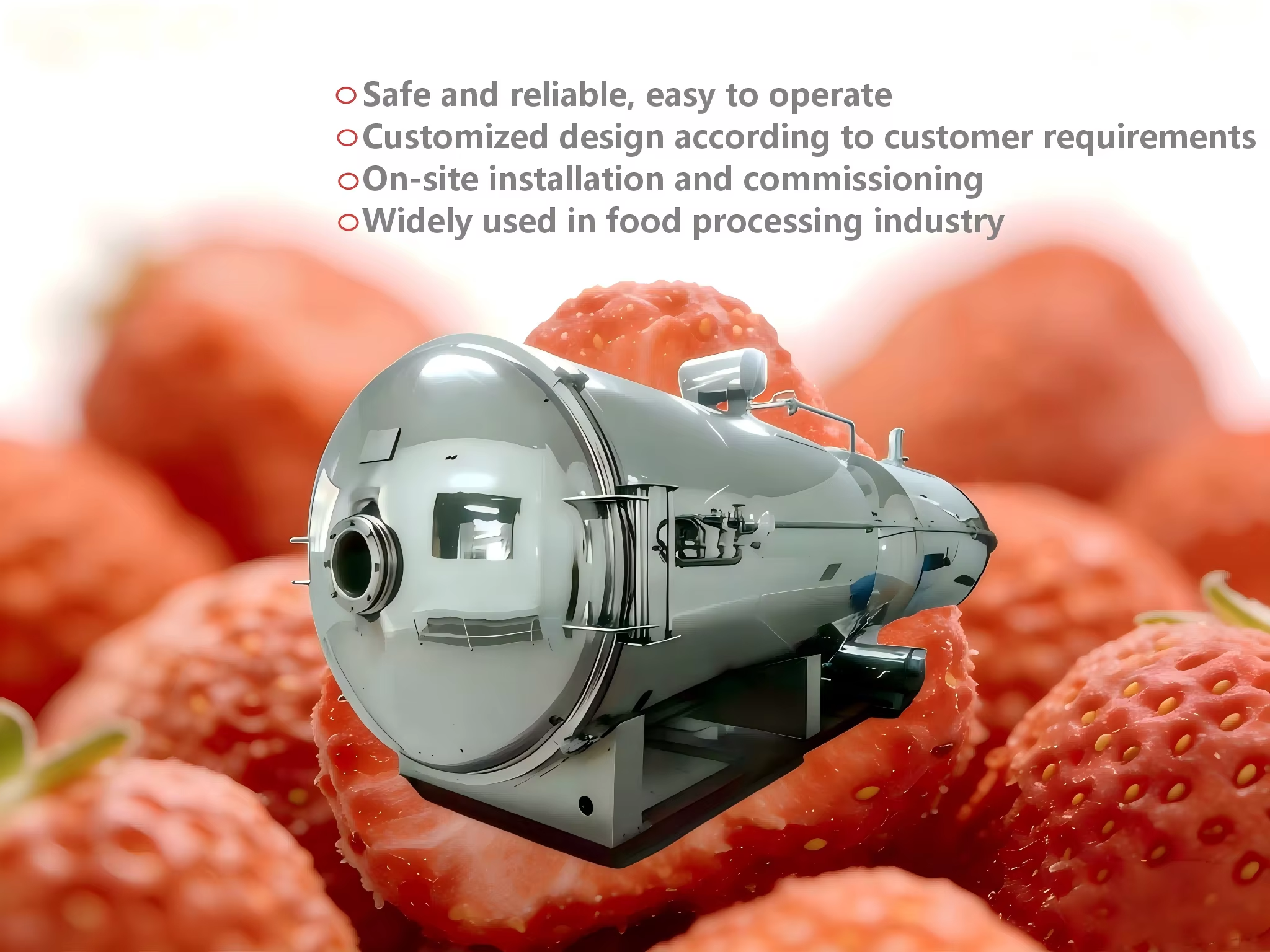
By optimizing the freezing, vacuum, and drying processes with precise temperature and pressure control, our freeze dryer helps ensure uniform drying, stable color and shape, consistent product quality, and efficient production, while reducing energy consumption and manual operation.
Energy-Efficient Operation
Thanks to the optimized Bitzer compressor, intelligent PLC heating control, and high-efficiency vacuum system, our freeze dryer consumes 20%–30% less energy than conventional models of similar capacity.
Actual power consumption depends on load and cycle settings — we provide a customized energy cost estimate for your specific production volume upon request.
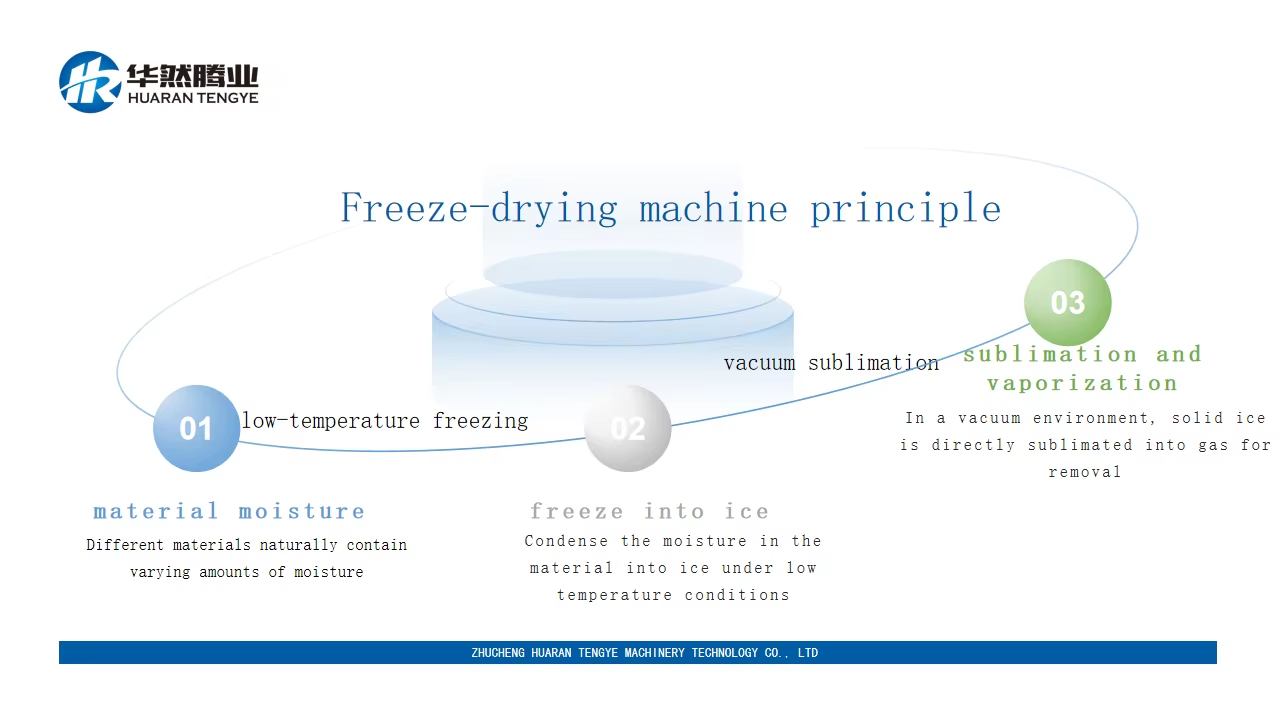
| Parameter | Specification |
| Cold Trap Temperature | -45°C to +80°C |
| Vacuum Level | <10 Pa |
| Shelf Temperature & Uniformity | -40°C to +70°C |
| Shelf Area & Loading Capacity | 10-200m2 |
| Ice Condenser Capacity | 10kg/24h |
| Drying Cycle & Power Consumption | 18-24h |
Note: All values are design specifications. Actual performance depends on product formulation, loading, and operating procedures.
Estimated Running Expenses (For Reference)
To give you an idea of the total cost of ownership, we have come out with the following estimating formula:
Cost of Power per Batch Estimated ≈(Power of Equipment × Running Time(hours) × Local Cost of Electricity(kW)) ÷ Output of the Batch (kg)
Example (Model FDG-50, whole strawberries):
Energy consumed: ~45 kW
Cycle time: 20 hours
Electricity cost per unit: $0.15/kWh
Input of batch of raw material: 500 kg (→ approx. 50 kg of finished product)
Cost of the power per kg of finished product estimated ≈ (45 × 20 × 0.15) ÷ 50 = 2.7$/kg
Please bear in mind that this is just an illustration. The specific consumption will heavily depend on what recipe, loading, and the environment conditions are. After placing the order, we will give detailed cost forecast report, based on a customer's product line and machine capacity.
| Model | Shelf Area (m²) | Batch Capacity (kg/cycle)* |
| FDG-0.5 | 0.5 | 5 |
| FDG-1 | 1 | 10 |
| FDG-5 | 5 | 50 |
| FDG-10 | 10 | 100 |
| FDG-20 | 20 | 200 |
| FDG-30 | 30 | 300 |
| FDG-50 | 50 | 500 |
| FDG-75 | 75 | 750 |
| FDG-100 | 100 | 1,000 |
| FDG-125 | 125 | 1,250 |
| FDG-150 | 150 | 1,500 |
| FDG-200 | 200 | 2,000 |
Capacity calculations are based on fruit materials with a typical moisture content of 90-93%.
The actual production output per hour may vary depending on the specific recipe, product characteristics, and loading method.
Customized solutions are available to meet special requirements, including different shelf areas and unique material handling needs.
Industrial Freeze-Drying Workflow (Strawberry)
| Step | Process | Industrial Consideration |
| 1. Pre-treatment | Cutting, washing, removing stems and optionally slicing or dicing. | To go with industrial-scale production, we advise using mechanical washing and cutting lines (optional integration available), which not only maintain uniform piece size but also lower the labor cost. |
| 2. Loading & Pre-freezing | Arranging the product evenly to the shelves. Pre-freezing to -35°C ~ -40°C for 6–10 hours(the length depends on load). | Uniform temperature distribution (≤ ±1 C) Our shelves ensure a uniform temperature distribution (≤ ±1C) to eliminate uneven ice crystal formation. Prefreezing can be carried out within the chamber or in a separate cold room - the advice is based on the customers production schedule. |
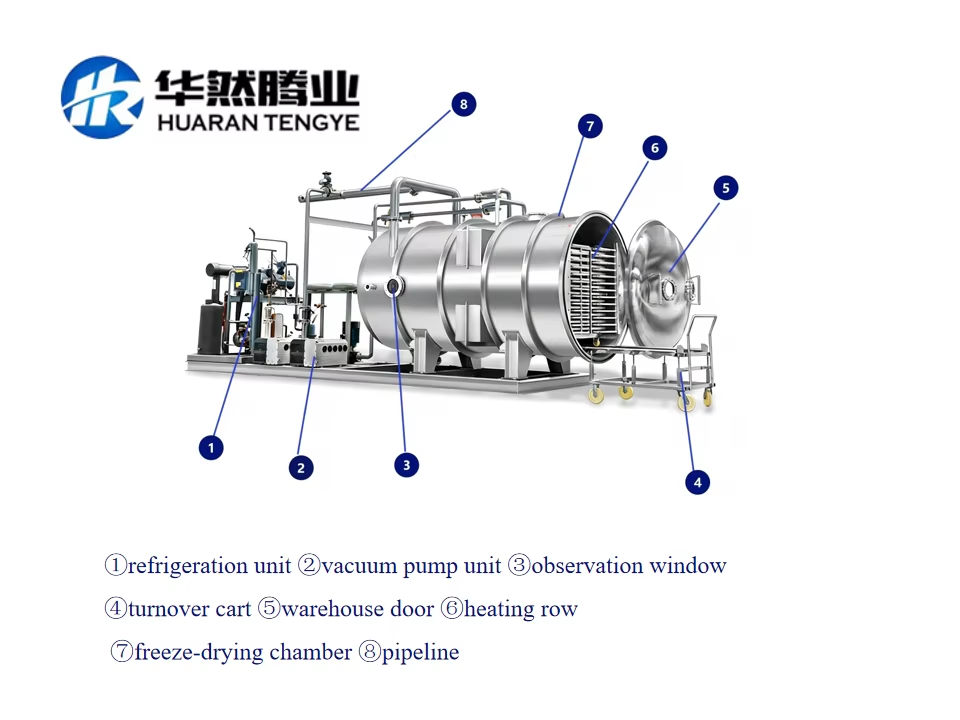
| 3. Primary Drying (Sublimation) | Vacuum pump system is first running, then the temperature on the shelf slowly increases from -30°C to +30°C with maintained pressure level (< 10 Pa). | Siemens PLC changes heating power in accordance with the temperature sensors of the product without causing the material to collapse or scorch. |
| 4. Secondary Drying | The shelf temperature rises to approximately +40 to +50°C in order to eliminate the bound moisture. | Determination of the end-point by using a pressure rise test guarantees the same final moisture content (<3%–5%) which is necessary for long storage. |
| 5. Unloading & Packaging | Replace vacuum by using dry nitrogen or filtered air. | The option of using nitrogen backfill can also be taken up to avoid oxidation of color-sensitive strawberry products. |
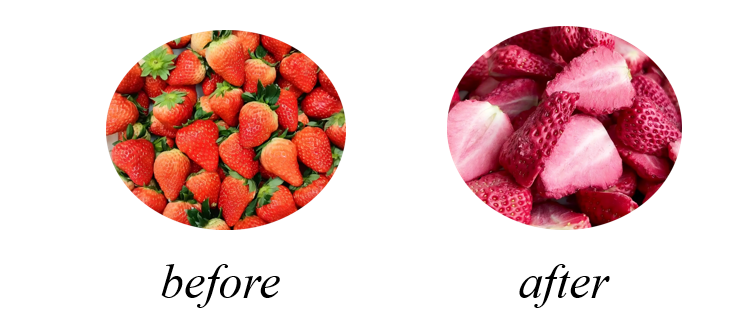
System Configuration
Refrigeration System
The compressor section is either a Bitzer (Germany) one or an equivalent semi-hermetic type opening compressor with same or higher performance.
R507 as refrigerant which is according to nowadays requirements.
Cooling Method: water cooling or air cooling is selected as per customer demand.
Vacuum system
The pump is composed of rotary vane pump and Roots multi-stage vacuum pump.
Leybold, Edwards, or high-quality domestic vacuum pump brands are used.
The ultimate vacuum pressure is ≤5 Pa.
Leakage rate: ≤10 Pa·L/s (measured and checked).
Control system
Siemens S7-1200 PLC controller is the programmable logic controller.
Operator Interface: A 10-inch touch screen display, Siemens or WEINVIEW.
Data recording: the curves of temperature, pressure, and time, respectively, can be saved and printed externally via USB or Ethernet connectors.
Control modes: It is capable of being operated manually or being controlled automatically by a recipe.
Bottle for Reactions
Body: This product body is made entirely of food-grade stainless steel SUS304.
Hairpin Interior: High-quality surface mirror polished, with smooth surface of Ra ≤ 0.8 μm.
Exterior: Brushed or painted surface as needed.
Valve Cover: There is a swing-type vacuum-sealing valve door fitted with a silicone sealing gasket in the reaction vessel for airtight sealing.
Founded: 2006 (with 19 years in the industry)
Factory size: 18,000 m²
R&D team: 22 engineers
Production lines: 4 assembly lines
Annual capacity: 120+ units/year
Certifications: ISO 9001, ISO 14001, CE, ASME
Component cooperation: Bitzer, Leybold/Edwards, Siemens, Emerson
Export countries: over 40, including the USA, Germany, Japan, South Korea, Australia, Brazil
Number of equipment delivered since 2010: more than 800
| Item | Details |
| Standard Lead Time | Around 45 working days after order confirmation (for models up to FDG-50) |
| Large Models | Around 60 working days for models above FDG-50 |
| Installation & Commissioning | On-site support available with additional service and travel costs |
| Spare Parts Supply | Critical spare parts can be prepared for shipment within 48 hours |
| Service Item | Commitment |
| Warranty Period | 12 months from commissioning date (core components) |
| Response Time | Remote troubleshooting within 4 working hours (via video call or TeamViewer) |
| Spare Parts Delivery | Critical parts shipped within 48 hours (worldwide, via DHL/FedEx) |
| On-site Service | Available for installation, commissioning, and training (travel & accommodation costs not included) |
| Software Updates | Lifetime free PLC recipe software updates |
| Remote Monitoring | Optional IoT module for real-time performance monitoring and predictive maintenance |
Service Coverage: We have authorized service partners in USA, Germany, Brazil, and Southeast Asia to ensure local support.
What processing volume is possible in each processing session by using the strawberry industrial freeze dryer?
The batch processing is flexible, varying according to production demand and starting from 5kg to beyond 1000kg, which is quite an achievement.
How long will strawberry freeze-drying take?
As a rough estimate of the freeze-drying process from start to finish, if it is a whole strawberry it will take from 18 to 24 hours whereas if it is sliced or diced strawberries it will last around 12 to 16 hours depending on moisture and sugar levels within each respective strawberry variety.
Freeze-drying, what effect does it have on strawberries, both in terms of their nutritional content and their appearance?
Drying without freezing (i.e. a process that is essentially drying but using cold) preserves almost all food's original characteristics such as its color, flavor, and shape by using a method called sublimation, i.e. water is going out of a frozen food without forming a liquid first.
Freeze-drying preserves more than 95% of the original nutrients (including vitamin C and anthocyanins), as verified by third-party laboratory tests. The actual retention rate may vary slightly depending on the strawberry variety and pre-treatment method. We can provide test reports upon request.The flavor and color of a strawberry before being processed is still there, and its original shape is also preserved. The freeze-dried strawberry is a crispy treat with a very long shelf life and, if one is really concerned or cautious, no preservatives added.
What are the electricity requirements for a running set?
We manufacture machines for industrial purposes which can run under 3-phase (380-460 V) power with (50/60 Hz). To reduce running costs we have incorporated efficient components in terms of energy, such as bitzer/refcomp advanced compressors, vacuum optimized systems, and smart PLC-heating controls that will save up to 20%-30% energy compared with the conventional freeze dryers.
Do you comply?
We comply with the highest food-safety standards including FDA, HACCP, CE, etc. In addition, we make our equipment with stainless steel parts of the best foodgrade quality that can be trusted as safe food-contact materials without releasing any harmful substances. Our machines are certified to be CE, ISO9001, and GMP/FDA standard manufacturing requirements for processing clean food. Thus, our equipment does not cause the slightest danger to consumers.
Could this freeze dryer be used for other fruits or products?
Of course! It is possible to freeze-dry other fruits (e.g., durian, mango, berries, etc.), vegetables, meats, seafood, pet food, and herbs simply by changing the drying recipe set via the PLC touch screen.